15 speech delay activities for toddlers at home
By TalkpebbleUpdated
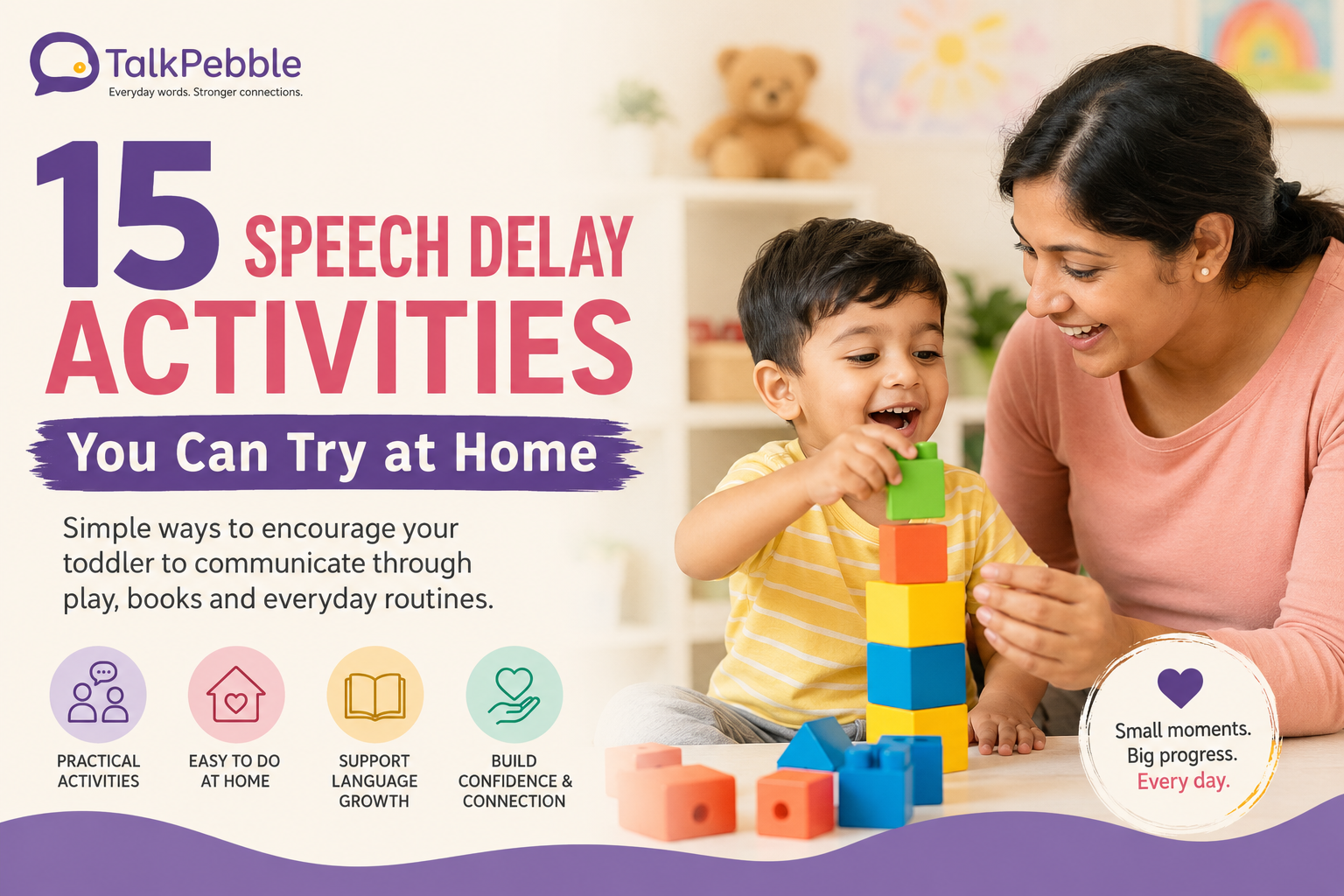
My 2- or 3-Year-Old Isn’t Talking Much? 15 Things You Can Do at Home
If your 2- or 3-year-old is using fewer words than you expected, you may be wondering:
“Should I be worried?”
“Is my child just a late talker?”
“Can I do anything at home to help?”
And perhaps the biggest question:
“Am I doing enough?”
You are not alone.
Many parents search for things like speech delay activities for toddlers, speech therapy at home, late talker, or child not speaking at age 3 because they want practical ways to support communication during everyday life.
The good news is that you don’t need to turn your entire day into a therapy session.
Small communication opportunities during play, meals, books, bath time, getting dressed, and daily routines can give your child more chances to understand language, communicate, take turns, and use words.
Here are 15 simple activities you can try at home.
First: Every Child Develops Differently
Children don’t all learn communication at exactly the same pace.
A child may understand much more than they can say. Another child may communicate mostly through gestures, sounds, or pointing. Some children begin talking later than their peers.
At the same time, persistent concerns about communication are worth discussing with a qualified pediatrician or speech-language pathologist.
Home activities can support communication, but they shouldn’t replace professional evaluation or speech-language therapy when it is needed.
Think of these activities as opportunities to communicate—not tests your child has to pass.
15 Speech Delay Activities You Can Try at Home
1. Follow Your Child’s Interest
Instead of deciding what your child should play with, watch what they are already interested in.
If they pick up a car, join them.
If they want blocks, build with blocks.
If they are looking at animals, talk about the animals.
Then add simple language around what they are already doing.
For example:
“Car!”
“Red car.”
“Car goes!”
You don’t need long sentences.
Start with what your child is already paying attention to.
2. Copy Your Child
If your child makes a sound, make the sound back.
If they clap, clap too.
If they bang two blocks together, copy them.
This simple back-and-forth can teach an important idea:
“When I do something, someone responds.”
That is the foundation of many early communication exchanges.
3. Add One Word
One of the easiest ways to support language at home is to expand slightly on what your child communicates.
If your child says:
“Ball.”
You can say:
“Big ball.”
If they say:
“Car.”
Try:
“Blue car.”
If they say:
“More.”
You can say:
“More bubbles.”
Don’t turn every interaction into a lesson.
Just give your child a slightly bigger version of the message.
4. Create Choices
Instead of asking:
“What do you want?”
try offering two choices.
“Apple or banana?”
Hold both where your child can see them.
Your child can answer with a word, sound, gesture, pointing, or reaching.
The goal isn’t only to get the correct word.
The goal is to create a reason to communicate.
5. Pause Before Helping
This one can feel surprisingly difficult.
If your child is trying to open a container, reach for a toy, or ask for something, don’t immediately jump in.
Pause for a moment.
Look at them.
Give them an opportunity to communicate.
They might:
- Point
- Look at you
- Make a sound
- Use a word
- Gesture
- Hand you the object
Respond to whatever communication they give you.
6. Turn Book Reading Into a Conversation
You don’t have to read every word on every page.
Look at the pictures together.
Point.
Comment.
Pause.
Let your child participate.
Instead of:
“What is this?”
“What color is this?”
“Where is the dog?”
over and over, try making simple comments:
“Dog!”
“Big dog.”
“Dog is running.”
Then pause.
Your child may point, make a sound, imitate you, or say a word.
All of those are communication opportunities.
7. Sing Songs With Pauses
Songs are naturally repetitive, which makes them useful for communication practice.
Sing a familiar song and pause before a predictable part.
For example:
“Twinkle, twinkle, little…”
Pause.
Give your child a chance to participate.
They don’t have to say the missing word.
A gesture, sound, movement, or attempt can still be meaningful participation.
8. Make Everyday Routines Talkable
You don’t need special toys.
Use routines you already have.
During getting dressed:
“Shirt.”
“Shoes.”
“Socks on.”
During meals:
“More?”
“Milk.”
“All done.”
During bath time:
“Water!”
“Wash hair.”
“Duck!”
These repeated routines give children predictable language they can hear again and again.
9. Play “Ready, Set… Go!”
This is a simple way to build anticipation and turn-taking.
Push a car.
Say:
“Ready…”
“Set…”
Pause.
Then:
“GO!”
You can use the same pattern with:
- Bubbles
- Swings
- Balls
- Toy cars
- Jumping
- Running
Eventually your child may begin anticipating the final word, gesture, or action.
10. Give Your Child a Reason to Communicate
Sometimes we make things too easy.
If your child can see their favorite toy but can’t quite reach it, wait.
Look at them.
You might say:
“Want it?”
Then pause.
Your child might point, reach, look, vocalize, or use a word.
Respond to that attempt.
Communication doesn’t have to begin with perfect speech.
11. Use “More” and “All Done”
These are useful concepts throughout the day.
During snacks:
“More?”
During bubbles:
“More bubbles?”
When the activity is finished:
“All done.”
Use the same words repeatedly in meaningful situations.
Over time, your child gets many opportunities to understand what those words mean and potentially use them.
12. Take Turns With a Simple Game
Communication isn’t only about vocabulary.
It is also about back-and-forth interaction.
Try rolling a ball between you.
Your turn.
“My turn.”
Roll it.
Then:
“Your turn.”
Wait.
Roll it back.
You can also use blocks, cars, bubbles, or any simple activity that naturally creates turns.
13. Play With Sounds
You can make playful sounds while playing.
A car might go:
“Vroom!”
A train:
“Choo-choo!”
An animal:
“Moo!”
A dog:
“Woof!”
Sound imitation can be a fun bridge toward more intentional communication.
Keep it playful.
14. Talk About What Your Child Is Doing
You don’t always need to ask questions.
Instead of constantly asking:
“What are you doing?”
try describing it.
“You are building.”
“Block up.”
“Car is going.”
“You found the ball!”
This gives your child language without putting them on the spot.
15. Make Communication Part of Fun
Perhaps the most important activity is simply:
Have fun together.
Play.
Laugh.
Take turns.
Follow your child’s interests.
Celebrate attempts to communicate.
Your child doesn’t need to perform perfectly for the interaction to be valuable.
The goal is to create more moments where communication feels useful, interesting, and rewarding.
What If My 2-Year-Old Has a Limited Vocabulary?
If your 2-year-old is using fewer words than you expected, it’s understandable to have questions.
Rather than focusing only on a word count, look at the bigger communication picture.
Consider whether your child:
- Understands what you say
- Uses gestures
- Points to communicate
- Looks toward things they want
- Tries to get your attention
- Imitates sounds or actions
- Enjoys back-and-forth interaction
- Is gaining new communication skills over time
These observations can be useful to share with your child’s pediatrician or a speech-language professional.
What If My 3-Year-Old Isn’t Speaking Clearly?
Parents often search for “unclear speech 3 year old” because they can understand their child but other people struggle to.
Speech clarity develops over time, and not every sound is expected to be perfect at the same age.
However, if you are concerned about how your child’s speech or communication is developing, don’t feel that you have to simply “wait and see.”
A pediatrician or speech-language pathologist can help you understand whether an evaluation would be useful.
What About Speech Therapy at Home?
Speech-language therapy can sometimes involve activities that parents can continue between professional sessions.
But speech therapy at home isn’t simply about making a child repeat words.
Good communication support can involve:
- Following the child’s interests
- Building turn-taking
- Supporting gestures
- Creating communication opportunities
- Expanding language
- Encouraging interaction
- Practicing communication during everyday routines
The exact approach depends on the individual child.
If your child needs professional support, a qualified speech-language pathologist can help determine what is appropriate.
When Should You Talk to a Professional?
If you are concerned about your child’s communication, you don’t have to wait until the concern becomes severe.
Consider discussing your concerns with your child’s pediatrician or a qualified speech-language pathologist, particularly if you notice:
- Little or no progress over time
- Loss of previously acquired communication skills
- Difficulty understanding everyday language
- Very limited ways of communicating
- Significant difficulty being understood
- Concerns about hearing
- Frustration because your child has difficulty communicating
Early professional guidance can help you understand what your child needs.
You Don’t Need to Become Your Child’s Therapist
This is something many parents need to hear.
You don’t have to spend hours every day doing structured exercises.
You don’t need a room full of expensive toys.
And you don’t need to turn every interaction into a lesson.
Instead, look for small communication opportunities throughout your normal day.
A snack can become a choice.
A book can become a conversation.
A bath can become a language routine.
A block tower can become a turn-taking game.
A walk can become a chance to point, notice, and talk.
These moments add up.
How TalkPebble Helps Parents Practice Communication Skills
Knowing what to do is one thing.
Knowing how to do it during a real-life moment with your child can be much harder.
That’s where TalkPebble is designed to help.
TalkPebble gives parents practical, everyday communication activities they can try with their child.
Instead of simply giving parents information, the goal is to help turn communication guidance into small actions parents can actually practice at home.
You can explore activities around:
- Taking turns
- Pointing and finding
- Making choices
- Copying actions
- Expanding words
- Looking at books together
- Using everyday routines
- Building back-and-forth communication
The focus is not on making your child “perform.”
It’s on creating more opportunities for meaningful communication.
One Small Activity to Try Tonight
You don’t need to try all 15 activities today.
Pick one.
Sit with your child for 5–10 minutes.
Follow what interests them.
Copy what they do.
Add one or two simple words.
Pause.
Give them a chance to respond.
Then follow their lead again.
Small moments of connection can become big opportunities for communication.
And if you’re concerned about your child’s development, remember: you don’t have to figure everything out by yourself. Talk with your child’s pediatrician or a qualified speech-language professional for individualized guidance.
Frequently Asked Questions
Is it possible to do speech therapy at home?
Parents can support communication development at home through play, routines, books, turn-taking, and other everyday interactions. However, home activities should not be considered a replacement for professional speech-language evaluation or therapy when a child needs it.
What are good speech delay activities for toddlers?
Simple activities include following your child’s interests, copying actions and sounds, offering choices, reading picture books, singing repetitive songs, playing turn-taking games, and creating opportunities for your child to communicate.
What should I do if my 2-year-old has a limited vocabulary?
Observe communication as a whole, including gestures, understanding, pointing, imitation, interaction, and progress over time. If you are concerned, discuss your child’s communication with a pediatrician or speech-language pathologist.
My 3-year-old isn’t speaking clearly. Should I be concerned?
Speech clarity develops gradually, but persistent concerns about how understandable your child’s speech is are worth discussing with a pediatrician or speech-language pathologist. They can determine whether an evaluation is appropriate.
Is my child just a late talker?
Some children do develop spoken language later than their peers. But the term “late talker” shouldn’t be used to dismiss ongoing concerns. A professional can help you understand your child’s individual communication profile.
A Final Reminder for Parents
You don’t need to have all the answers.
You don’t need to know exactly what to say every time.
And you don’t need to turn parenting into therapy.
Start with connection.
Follow your child’s interests.
Create opportunities to communicate.
Celebrate attempts.
And seek professional guidance when you have concerns.
You are not trying to make your child talk more. You’re helping create more reasons for your child to communicate.
TalkPebble — practical communication guidance for everyday parenting.
Start with one small moment today
Get simple parent-guided activities for everyday routines — download the app and start with one small moment today.

TalkPebble provides educational information only and does not diagnose or treat any condition.